 National service hotline:+86(0)755-2898 7706

1.Section 5.4: Display Trays – Style and Function
1.1 Core Purpose & Deployment Rules
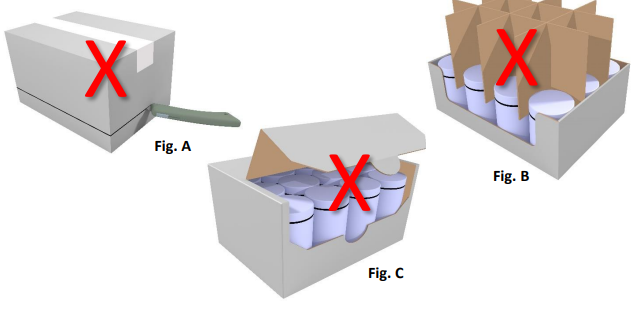
Display trays are only permitted when necessary for unit load stability or product damage prevention during pallet/shelf merchandising. All shipments must be display-ready, eliminating the need for box cutters or manual labor during in-store stocking (as illustrated in Fig. A).
1.2 Functional Design Requirements
- Product Support: Trays must securely contain products without relying on internal blocking dividers (as shown in Fig. B).
- Prohibited Features: Tear front panels, plastic strapping, tear tape, telescoping lids, and tray covers are strictly forbidden, with the following exceptions:
1. Exception A: Telescoping lids or tray covers are allowed for products distributed in layer quantities.
2. Exception B: Products shipped in individual case quantities may use a display tray with a telescoping lid taped to the bottom on two opposing sides.
- Containment & Distribution Alignment: Product containment inside trays must align with Costco’s distribution methods. Suppliers must confirm with their buyer whether distribution will occur via pallet, layer, or individual case quantities.
- Weight Limits:
- Maximum tray weight: 40 lbs / 18 kg
- Recommended case weight: 25 lbs / 11 kg (to support safe handling)
- Merchandising Priority: Display tray presentation is equally critical to sell unit packaging at the point of sale. Suppliers must optimize the interaction between tray and product packaging for maximum visual appeal.
2. Section 5.5: Display Trays – Design Specifications
2.1 Stacking & Interlock Requirements
- All trays must incorporate a design feature to prevent nesting of upper trays into lower layers during palletization.
- Stacking tabs for layer interlocking are only permitted for produce items, as they hinder efficient inventory replenishment for other product categories.
2.2 Front Panel Height Standards
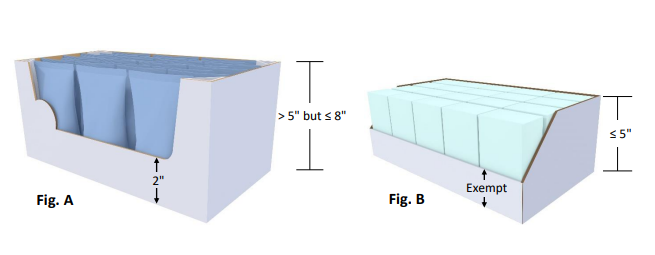
Trays require a minimum 3" / 8 cm front panel height, with exceptions for single-stacked products:
1. Product height > 5" / 12 cm but ≤ 8" / 20 cm: Front panel height may be reduced to 2" / 5 cm, provided the remaining three sides maintain a minimum height of 4" / 10 cm (Fig. A).
2. Product height ≤ 5" / 12 cm: Trays are exempt from minimum front height requirements (Fig. B).
- Products that bear 100% of their own load weight may use low-profile trays, so long as they meet the front panel height rules above.
2.3 Tray Sizing & Pallet Utilization
- Multi-Unit Trays: For trays holding multiple sell units, a minimum of five units per layer is required to support Front End reuse.
- Large Pallet Tray Restrictions: 48" x 40" / 121.9 cm x 101.6 cm large pallet trays are only allowed under two conditions:
1. When a layer contains 24 or fewer sell units.
2. For Costco-designated very high-volume goods (e.g., chips, salty snacks).
3. Compliance & Operational Alignment
All display tray designs must align with the full Section 5 packaging framework, ensuring consistency with sell unit specifications (Sections 5.1–5.3) and Costco’s end-to-end logistics and merchandising workflows. Non-compliant tray designs may result in delayed stocking, rework costs, or rejection at receiving facilities.
Products
Pod Display
Color box
Pdq
Display
Mobile: +86-135 9046 8765/136 6260 0846
E-mail: alan@ctk-hk.com
Tel: +86(0)755-2898 7706
WeChat: 135 9046 8765
Website: www.ctk-hk.com
Add: Building 16, AIPARK, No.2, Baolong 4th Rd., Longgang District, Shenzhen, China


Copyright 2004-2024 CTK PACKING ASIA . All Rights Reserved.